Historical Patents: What Old Drawings Reveal About Invention
Historical patents are technical documents and snapshots of human imagination at the same time. Their drawings reveal which everyday problems mattered, which solutions seemed plausible, and how an idea became a mechanism that could be described and claimed.
The short version
A patent does not prove that an invention succeeded in the market. It records a claimed technical idea. Drawings, patent number, inventor, and grant date therefore work best together. Readers can understand many documents without specialist training by following components, motion, material, and intended result.
A patent is not proof of commercial success
A grant shows that a claim passed the relevant legal process. It does not establish that the device was manufactured, sold, or profitable. That separation makes archives fascinating: familiar ancestors of modern products sit beside ambitious proposals that may never have left the page.
Readers should distinguish the technical idea, the legal claim, and later use. A design that looks eccentric today may address a serious problem, while an early version of an ordinary object can appear remarkably complicated.
How to approach a patent drawing
Start with the overall view, then follow reference numbers across sections and details. Lines, cutaways, and alternate positions show how parts connect or move. The drawing is not decorative art; it is a visual extension of the written specification.
A practical sequence is purpose, main components, movement or energy, and result. Answering those four questions is usually enough to understand why an invention differs from what came before.
- Identify the whole device and its stated purpose
- Match reference numbers between views
- Trace movement, force, or material
- Place the grant date in historical context
Why ordinary objects are especially revealing
Dishwashers, paper bags, and bicycles now feel inevitable. Their patent histories show intermediate designs, competing solutions, and practical constraints. Innovation becomes a process rather than a single flash of genius.
Unlikely devices matter too. A cork swimming suit or a vehicle built around one enormous wheel reveals how open the field of possibility once seemed. Even an abandoned path can explain which assumptions later changed.
Turning an archive into an accessible book
A useful patent book must curate and explain without hiding its evidence. Complete drawing sheets, numbers, dates, and inventor names allow further research. Commentary should translate the mechanism rather than replace the source.
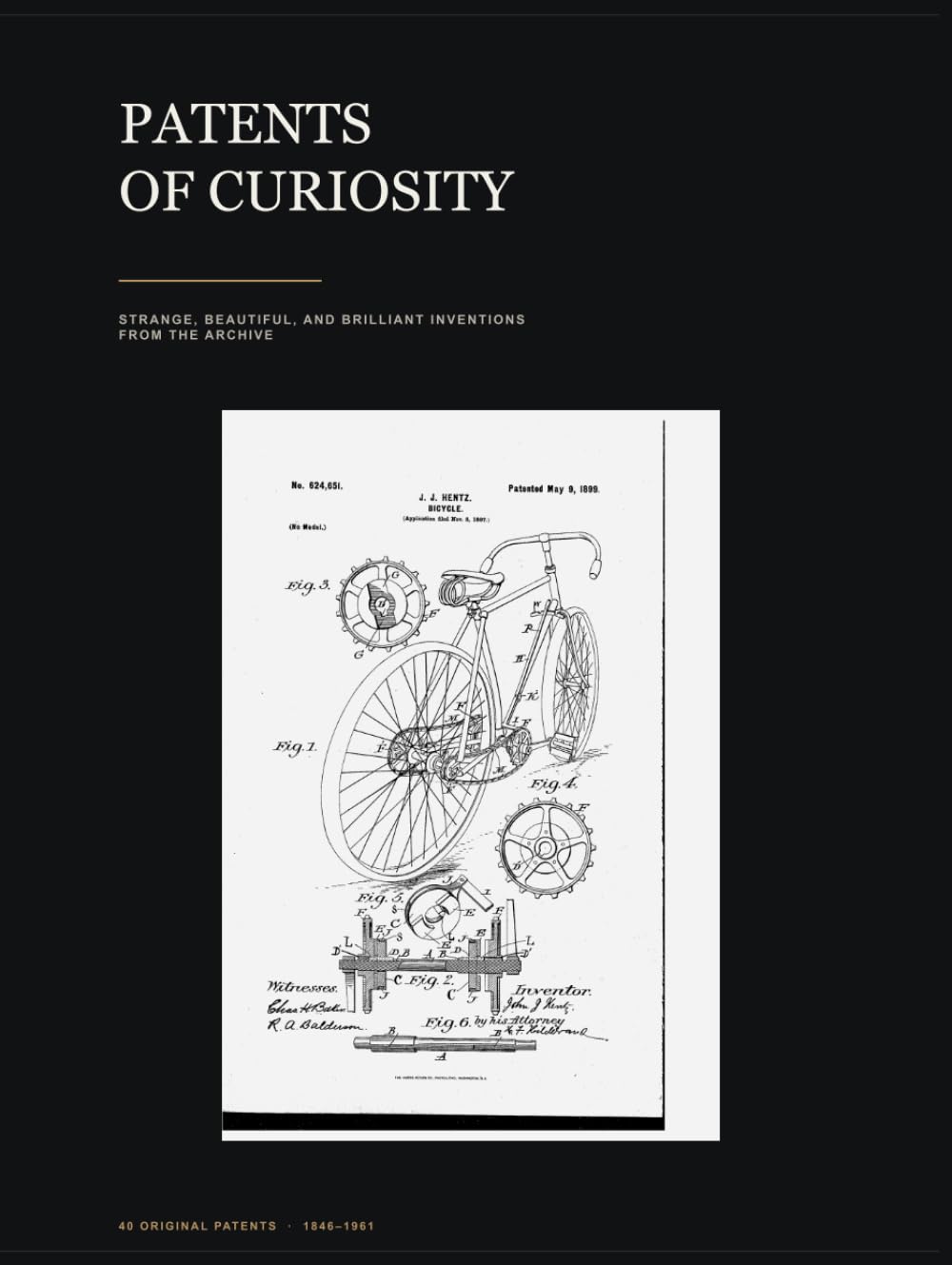
Patents of Curiosity organizes forty documents into five thematic chapters and places each drawing opposite its story. The English text is designed for readers without an engineering background while preserving the identifiers needed to explore further.
Sources and further reading
Books that fit this topic
The hardcover pairs forty original patent drawings with accessible explanations and source details.
Patents of Curiosity: Strange, Beautiful, and Brilliant Inventions from the Archive
A 100-page engineering coffee-table book exploring 40 strange, beautiful, and brilliant historical U.S. patents.
Common questions
Can historical patents be viewed for free?
Many patent offices and digital archives provide published documents online. Patent numbers and inventor names are the most reliable search keys.
Does a patent mean the invention was built?
No. A patent records a legal claim; manufacturing and commercial success are separate questions.
Do I need technical training?
Not for a basic understanding. Clear explanations and complete drawings make purpose and mechanism approachable step by step.
More articles
Western Noir and Weird Western: When the Old West Turns Unsettling
Learn how western noir and weird western reshape the Old West through mystery, conflicting witnesses, moral ambiguity, and quiet horror.
Read the article →Illustrated Short Stories: A Complete Book for One Evening
Learn why compact illustrated fiction can deliver a complete reading experience and what to check about length, artwork, and resolution.
Read the article →